

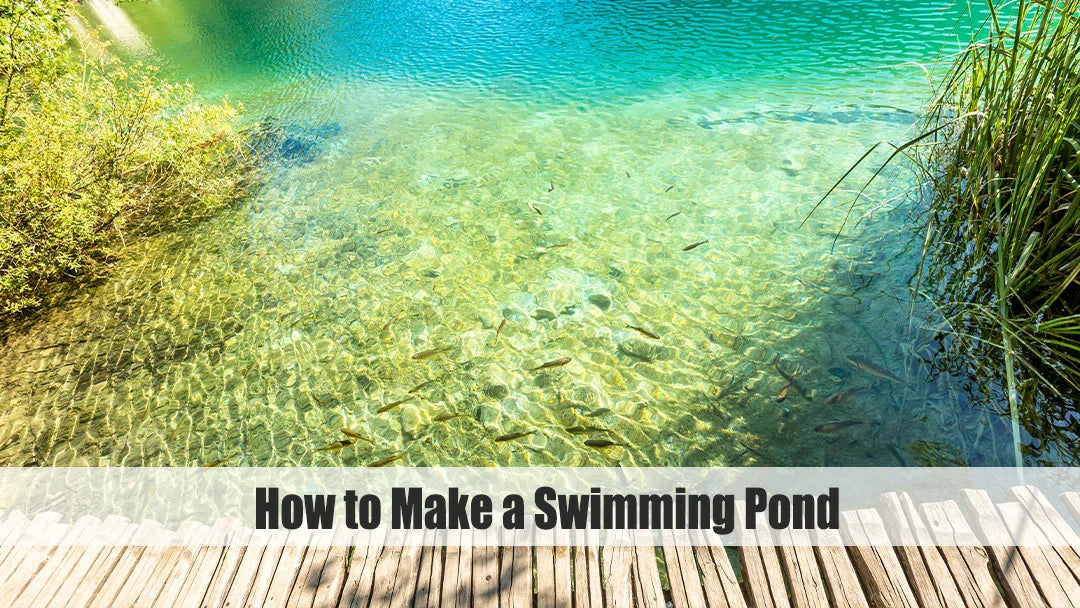
For most people, the concept of a swimming pond begins with the simple idea of building a swimming area with easy access and clean water in a location more like a lake than a swimming pool followed by the feeling of hesitation.
Will the water remain clean?
Will it turn green?
Is it safe?
How difficult is it to maintain compared to a pool?
Of course, this is a fair question. A swimming pond looks deceptively easy to implement when it has been done correctly. This is not necessarily an ease of implementation but rather the result of good planning. Of course, the best thing is that a natural swimming pond has nothing to do with chemicals, maintenance, or machinery.
Introduction -- The Beauty of a Natural Swimming Pond
The natural swimming pond is not promoted as a normal swimming pool would be.
There are no sharp edges, bright blue tiles, or the smell of cleaner in sight. Instead, the water seamlessly integrates into the landscape. Edges with soft forms are found along the vegetation. Reflections on the pool show trees, clouds, and light, and not a pool chair.
It is not only the appearance of swimming ponds that draws people there, it is also the experience. The sensation of the water is different. It is colder in summer, kinder to your skin. It is a quiet water too. The activity of swimming itself is like wading into a pond, not walking out into a swimming pool.
In this regard, any homeowner whose interests lie in nature, sustainability, and enjoyment as opposed to shortcuts, will definitely find such a pond to be the most genuine and appropriate solution.
Natural Swimming Pond: Complete Guide
On inspection, it seems that the swimming pond is rather straight forward in function. There is a good deal of both separation and unity in its function.
Usually, natural pools are known to have two functional aspects. These aspects will involve the swimming area that is free from plant life as well as debris. The other one will be the regeneration zone that involves plants, gravels, as well as certain microorganisms for the cleaning process of the water.
There are also continuous, though slow, movements between the regions. This results in the addition of oxygen to the process. There is a development of beneficial bacteria in areas around the roots of plants, rocks, and filters. The bacteria decompose the organic waste materials and excess nutrients. This is the process responsible for the clarity of the water.
Flow is therefore more valuable compared to power for this reason alone. For example, when it comes to pond pumps and filters for nature-friendly gardens from Poposoap, it is essential to work in cooperation with nature rather than against it.
Step-by-Step Guide: How to Make a Swimming Pond

Each swimming pond is unique, and all follow basically the same cycle.
The first consideration is location. The ideal location for your pond is one that gets partial sunlight. This is enough for plant growth, but it is insufficient for algae. Areas underneath trees may seem ideal, but many leaves will accumulate.
After choosing a site for construction, excavation follows. Depth is very important, both for a comfortable place to swim and for a favorable temperature. Ponds that are shallower tend to be warmer. The area around swimmers is usually where there is a deep portion with a lower temperature in warmer seasons.
After excavating the hole for the pond construction process, the pond liner is installed inside it. This is the foundation of this aquarium setup; it has to be durable as well. Further installation of the gravel/substrate material is of particular importance for the regeneration tank in this aquarium in particular
Secondly, there is the issue of circulation and filtering. There are pumps responsible for ensuring smooth circulation of water from one zone to another. There are filters geared towards supporting biological activity rather than substituting it. Natural pond filters from Poposoap put all this into consideration.
Thirdly, plants are gradually introduced to the pond. Weeks and months are required before the pond can settle enough for swimming to take place.
Selection of the Plants Used in Swimming Pond Construction

Aquatic plants assist with water oxygenation. Marginal plants retard water flow, which helps retain fine sediment. Floating plants offer shade. This helps control water temperature, as well as algal growth.
Plants require consideration of factors such as climate, depth, and pond size. Not having enough plants can make the system too exposed. Too many may impede water circulation. This is mastered through observation.
Many people who build their first pond underestimate the importance that plants will add. Once they are established, they work hard to do the job that chemicals do for regular pools.
How to Clean a Pond for Swimming

Nevertheless, there is remarkably little literature on the topic of swimming ponds in one area: pond maintenance.
You do not "clean" a natural pond like you would a regular pool. You do not shock it, balance chemicals weekly. It's all about fixing a naturally dynamic system.
The leaves are scooped out. The sediment can be vacuumed off at the bottom of the pond once a year. The filter may be checked to find out if cleaning is needed. The pump may be checked for free flow.
There could also be algal blooms. This could happen within the first year after completing the installation process. This is a normal process, whereby there could sometimes be no need on your part, because it is achieved when plants grow.
Cost And Maintenance Considerations
The construction of the swimming pond is an investment project; although, it is most probably not any more expensive than the installation of the swimming pool.
The upfront costs vary with regard to their size, material, and complexity of designs. In some cases, it may be a pool investment amount. The difference will be seen in the long run.
There are no costs for chemical supplies for swimming ponds. The energy costs may be lower, especially for pumps that are energy-efficient and/or solar-powered. Maintenance costs are usually seasonal, not weekly.
The design philosophy of Poposoap correlates well with a long-term outlook. By emphasizing robustness, universality, and efficiency, there is a clear focus on noiselessness over efforts required for its maintenance.
Conclusion -- Dive into Nature's Pool
However, a swimming pond requires something different from its taker. It challenges you to observe, not control. To respond, not react. To realize that nature has a pace of its own. In exchange, it delivers water that is alive, a landscape that constantly develops in relation to the seasons, and an experience that no traditional pool is able to deliver. While a natural swimming pond is a way to beat the heat, for those who are willing to think ahead, this pool becomes much more. The natural pond becomes integrated into a garden's ecosystem.
READ MORE: Affordable Pond Filter with Pump Fountain Kit Review

P2326D 40W 660GPH AC Pond Filter Fountain with Light
$89.99
Keep your pond water clear with the P2326D AC pond filter fountain. Includes pump, multi-stage filtration system, and built-in light for night beauty.
FAQs About Swimming Pond Design & Maintenance
Yes, when it is well designed and wellbalanced. Nature is based on life, not on chemicals.
A healthy pond does not smell. Smelling suggests the presence of stagnated water or inadequate circulation.
Swimming ponds, with adequate depth and supervision, are family-friendly.
In most cases, ponds are ready within one to three months after the planting process.


Laisser un commentaire
Tous les commentaires sont modérés avant d'être publiés.
Ce site est protégé par hCaptcha, et la Politique de confidentialité et les Conditions de service de hCaptcha s’appliquent.