

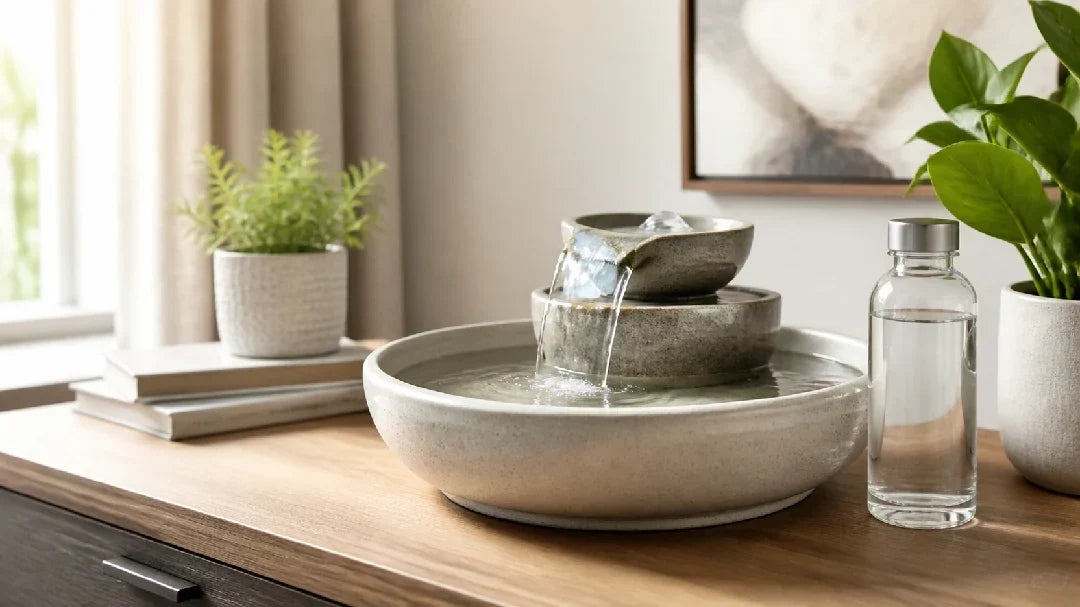
Short answer: Using distilled water in indoor fountains could help, but it isn't mandatory. I understood this the hard way after creating an indoor fountain on my desk. I used tap water at first, but several weeks later, I saw white stains near the edges and inside the pump.
This is why I researched whether distilled water for indoor fountain use could make a difference. In this post, we will go through what actually matters, particularly if you are planning an indoor DIY water fountain project.
Why Distilled Water Is Often Recommended for Indoor Fountains
The answer is yes; it is recommended because it will keep everything cleaner.
Distilled water is obtained by heating water to its boiling point and then letting it condense back into liquid form. Therefore, it contains only water itself, with minimal other elements.
What Happens with Regular Water
Most tap water contains natural minerals like calcium and magnesium.
As a result, over time, it could cause the following issues:
- White stains (scale)
- Deposits in the pump
- A decrease in water flow

Why Distilled Water Could Help
Because it contains fewer minerals, distilled water prevents buildup.
As a consequence, there would be:
- Less cleaning
- Improved long-term performance of the pump
- A cleaner-looking water feature
However, it wouldn't increase the power of the fountain.
Do You Need to Use Distilled Water for Your Indoor Fountain?
No, you don't have to use distilled water for an indoor fountain.
People successfully use tap water without any significant problems.
When Tap Water Works Fine
If the tap water in your area is relatively soft, it will have a lower concentration of minerals.
Thus, you won't have many problems with deposits, and cleaning will be easier.
When Distilled Water Could Be Better
On the contrary, distilled water becomes more relevant if you use hard water.
It helps avoid:
- Frequent cleaning
- The formation of residues
- Gradual pump wear
Therefore, it is up to you based on water quality and the desired maintenance frequency.
Distilled Water for Indoor Fountains vs. Other Types of Water
Let us compare the options.
Distilled Water
- Very low concentration of minerals
- Minimal residues
- Increased cost
- Low maintenance effort
Tap Water
- Contains minerals
- Could form deposits
- Low cost
- More maintenance
Filtered Water
- Fewer impurities
- Remains mineralized
- Medium price
- Moderate maintenance
Using a proper water filtration solution can also help reduce debris and support cleaner water in larger decorative water features.
Bottled Water
- Depends on the specific brand
- Could contain minerals
- Higher price
- Inconsistent results
Based on personal experience, distilled water is the easiest option, but it isn't mandatory.
What Indoor Fountain Owners Often Forget About
Water type is not all that matters in indoor fountains.

Pump Maintenance Is Crucial
Even when using distilled water, pump maintenance remains relevant.
Airborne particles like dust and small debris can enter the system.
The Water Level Gradually Dwindles
Any indoor fountain loses water due to evaporation—the process of transformation into vapor.
If the water level drops too low, the pump will start running dry, which will damage it.
Placement Is Relevant Too
Indoor fountains located near windows and airflow zones accumulate more dust than others.
Consequently, maintenance will become more frequent regardless of the water type.
What Should You Use in an Indoor DIY Water Fountain Setup?
If you create an indoor DIY water fountain setup, distilled water could be the right option initially.
It helps avoid initial problems during the adjustment process.

What Pump Should You Choose for an Indoor Fountain?
Water quality is crucial, but the pump is also important.
You need to consider the following characteristics:
- Noiseless operation
- Compact dimensions
- Simple maintenance
Portable pumps like those from Poposoap are created for indoor fountain use. Thus, they are perfect for DIY projects.
For other small water features where access to electricity is limited, a solar fountain pump can be a practical alternative.
How to Balance Different Factors
You can start with distilled water and then change it later if necessary.
- Start with distilled water initially.
- See how your indoor fountain operates.
- Switch to tap water if maintenance remains easy.
Conclusion
Using distilled water for indoor fountains is useful, but it isn't mandatory.
It prevents mineral deposits and makes cleaning more convenient.
However, tap water works perfectly fine if the water hardness is moderate enough.
Remember that you should maintain proper water quality, manage your pump effectively, and clean it regularly.
All fountain pumps from Poposoap are designed to operate quietly and simply; thus, they are appropriate for water fountains.
If you are considering a larger garden water feature in the future, Poposoap also offers waterfall solutions designed for continuous water circulation.

SPF130 8W 80GPH Solar Pond Filter Fountain with Battery
$59.99
Solar pond filter with battery backup: 8W panel + 3000mAh battery, multi-stage media, quiet dry-run protection. Solar powered pond filter with battery backup.
FAQ
Do I Need Distilled Water for My Indoor Fountain?
No, but it would prevent mineral deposits and make cleaning easier.
Can I Use Tap Water Instead?
Yes, particularly when the water hardness is moderate enough.
Why Does My Indoor Fountain Produce White Stains?
It occurs because of minerals in tap water.
How Often Should I Clean My Indoor Fountain Pump?
Once every few weeks, depending on usage and water hardness.



Laisser un commentaire
Tous les commentaires sont modérés avant d'être publiés.
Ce site est protégé par hCaptcha, et la Politique de confidentialité et les Conditions de service de hCaptcha s’appliquent.