

Introduction
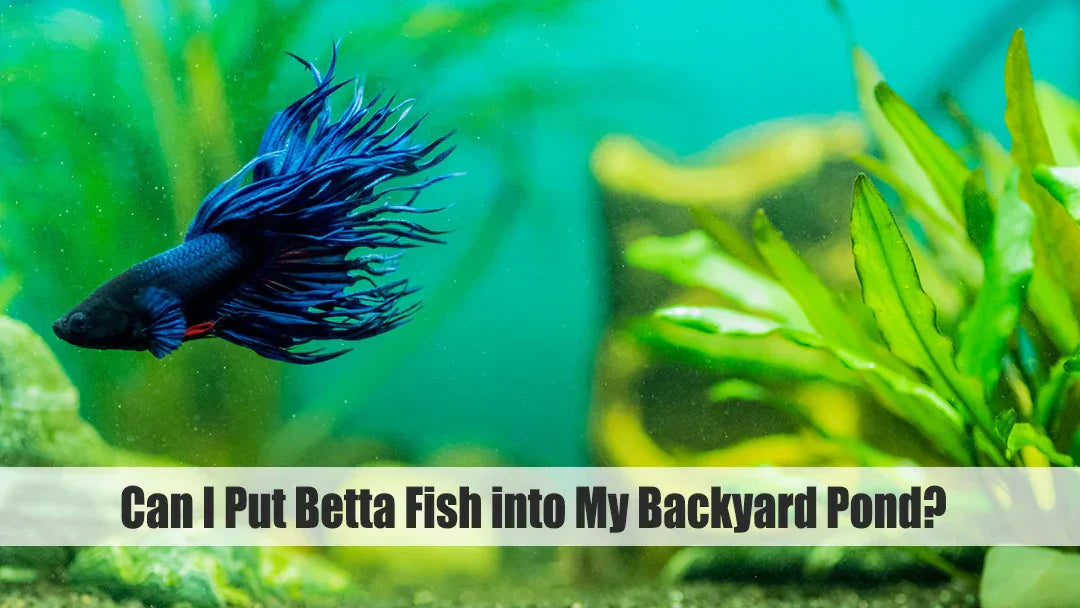
This is a question that always begins with the best of intentions. A person looks at their betta tank and then looks at their backyard pond, thinking: Wouldn't it be better for the fish?
I've seen this question posed a dozen different ways, but it all boils down to the same thing: "Can a betta fish live in a pond?"
The honest reply is, most of the time, no. Betta fish do not live in a pond in the usual sense of the word. They are tropical fish that require very specific environments, and most backyard ponds do not.
That doesn't mean that the concept is impossible. It just means that the risks are usually underappreciated. In order to better understand why that's true, it's important to examine where betta fish are from, as well as just how different a pond is from a tank.
The True Origin of Betta Fish
Betta fish or Siamese Fighting Fish occur in Southeast Asia. In the wild, betta fish can be found in low and sluggish bodies of water like paddy fields, ditches along the side of the road, and sometimes in seasonal floodplains.
These environments share a few common factors:
- Temperature is warm.
- The water is shallow.
- The water flow is slow.
- Oxygen levels can be low.
It is for these reasons that betta fish developed the labyrinth organ.
This adaptation results in people thinking of bettas as "tough" fish. The reality is that they are specialized fish. Betta fish can live in low-oxygen environments, but they cannot tolerate low temperatures, high temperature differences, and rapid current. These differences and similarities hold prominence in diverse surroundings, including aquatic containers and pond environments.

Can Betta Fish Survive in a Backyard Pond?
Is it technically true? Very rarely.
One will usually find that the temperature changes will be more extreme in the average household pond compared to the aquarium system. Night temperatures can drop quickly even in more tropical areas. A pond can be warm during the day, yet it can be dangerously cold by the next morning.
Another aspect to consider is depth. Betta fish require shallow water. The water requirements are such that access to the top should be easy. Such requirements may be a challenge in ponds because of their depth. Such depth could be modified by plants or a water pump.
Predators — that is the last problem, and it is quite common that it is what tips the scales. Being readily available to them, they become prey for any variety of predator: birds, frogs, larger insects, other fish. They don't do any favors with their fins or swimming.
Hence, despite the fact that some examples may exist regarding betta fish surviving in external ponds, these examples typically occur in highly controlled environments regarding:
- Shallow, inland water
- No predators
- No strong filtration flow

Moreover, when it comes to survival, it does not always translate to good betta care. Stress could appear in the form of illness or reduced life span.
Long-time enthusiasts are usually conservative for a reason. This is shown in the discussions in the community.
Are female betta fish a better choice for outdoor setups?
There's a common perception that female betta fish are better suited for ponds because they're less aggressive. Sometimes, they can even be socialized to live in a group. However, this is a common myth that's being perpetuated, but it doesn't give you the whole perspective.
Female bettas may not be as territorial as males, but they have the same requirements as males in regard to the environment. They still need warm, stable water. They are still susceptible to cold stress effects. And they are still easy prey in the wild.
A controlled environment is necessary in order for the grouping to work. Pond environments are not controlled. Female fish grouped in ponds would not thrive.
Why it matters. The recommendations for Siamese Fighting Fish care and management, derived from research, involve maintaining stable and controlled environments even in commercial settings and not in outdoor environments where factors can vary unpredictably (Care and Use of Siamese Fighting Fish (Betta splendens) for Research).
Safer Alternatives That Make More Sense
Where the point of building a pond is to 'give the betta a better life,' there are other ways to achieve this.

An alternative to using ponds would be to use containers.
There are large tubs, barrels, as well as pond containers that are ideal, especially in warmer seasons. These will help you control the environment. You can control the water, make the flow slower, or shift the fish inside depending on the high or low temperatures.
This is much more like natural shallow wetlands than ponds are.
Enhancing Indoor Betta Fish Keeping
In truth, most bettas will actually thrive in a well-planted aquarium with a weak current from a filtration system. This will give bettas much more relief than a pond could. Having floating plants with calm waters and constant temperatures is more beneficial than space could or would ever be.
How to Select Fish Suitable for Fishponds
If one's plan is to keep fish in the pond, then choosing fish that have adapted to such an environment would be much preferable. In fact, goldfish can withstand temperature changes well.
For such fish, proper water flow and filtration are also required. This can be accomplished by using such items as the 40W 660GPH AC Pond Filter Fountain with Light by Poposoap. It does not affect the conclusion that betta fish are not among the proper pond fishes.
Conclusion
But can you keep a betta in your backyard pond? In most cases, it is not a good idea. Bettas prefer a warm tropical habitat in shallow water. Your backyard ponds, even if beautiful, are just not reliable enough for bettas.
Though these setups may just work well for a given set of circumstances, they still have to be closely monitored. For the average betta breeder, it would be more advisable to raise the fish in aquariums or controlled containers.
If you're more interested in fish that are easier to keep in an outdoor pond, then this guide is where you want to start: What Type of Fish is the Easiest to Keep in a Pond?

P2300 40W 660GPH AC Pond Filter Fountain with UV Clarifier
$89.99
All-in-one pond filter with UV light: 660GPH pump for 1180-gal ponds, 3 nozzles, diverter valve, multi-stage media. Fish pond filter with UV light.
Frequently Asked Questions
Are female betta fish more secure in an outdoor setting than males?
No. They are equally vulnerable to temperature and predators.
Do betta fish need still water?
Yes. A strong current can be stressful.
Can heaters make a pond safe for betta fish?
Heaters are helpful, but they will not usually provide a constant environment for an entire pond.
What type of fish are suitable for backyards?
Goldfish and some indigenous species are more tolerant of outdoor conditions.

Laisser un commentaire
Tous les commentaires sont modérés avant d'être publiés.
Ce site est protégé par hCaptcha, et la Politique de confidentialité et les Conditions de service de hCaptcha s’appliquent.