

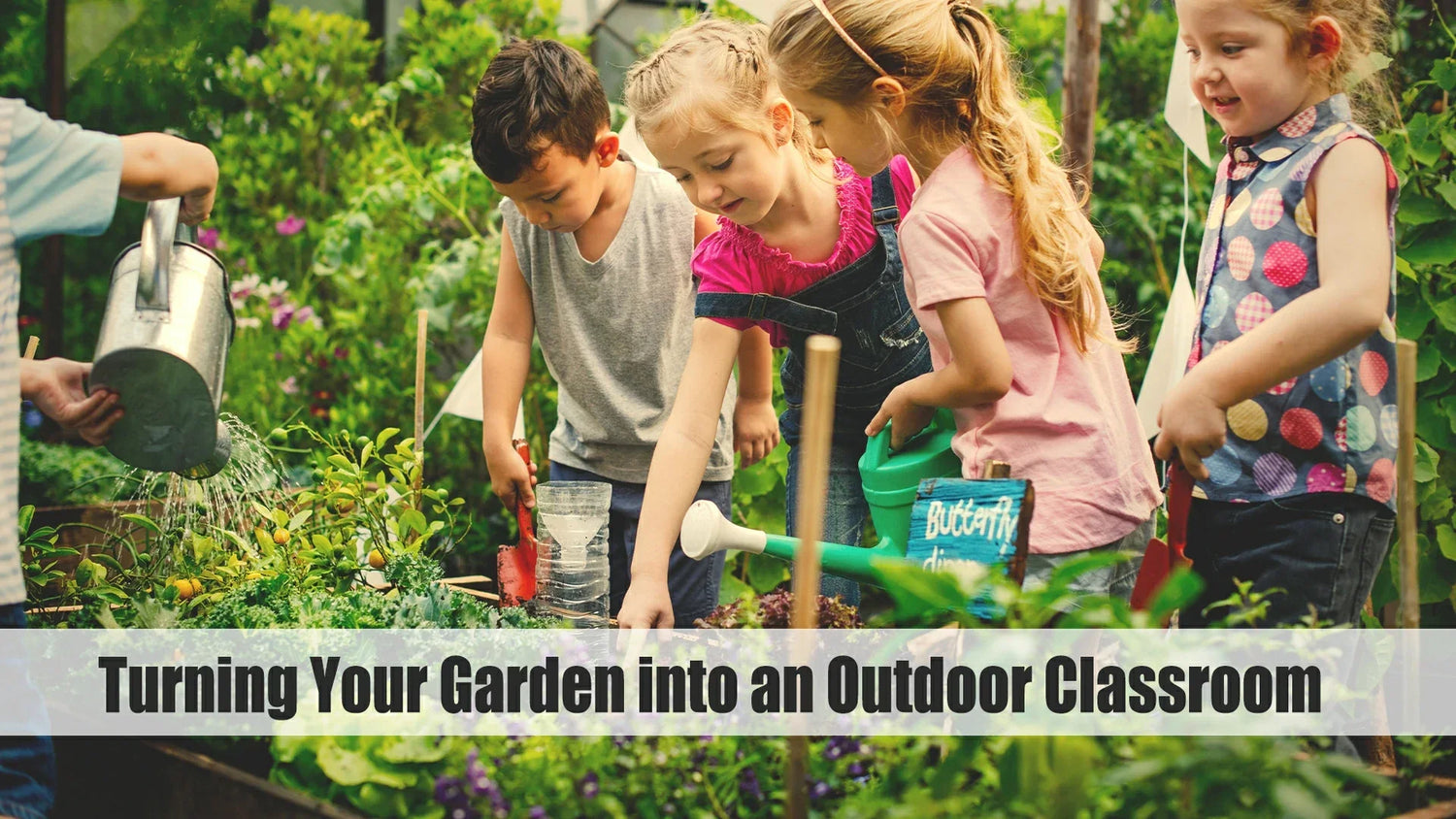
Outdoor classrooms are a popular alternative to traditional classrooms currently gaining increasing popularity amongst parents and educators. Providing a more immersive and hands-on setting, these open-air classrooms offer a more engaging, sensory-rich learning experience that fosters curiosity, creativity, and deeper understanding in children's education.
Gardens are a great location to set up your outdoor classroom, and there are a ton of ideas to model your learning garden after. In this article, we will share with you all you need to know about turning your garden into an outdoor classroom, why doing this is a good idea, and how to get it done.
Why Transform a Garden into an Outdoor Classroom?
If you have an outdoor garden, then you have all you could ever need for an outdoor classroom: an open-air space that can be converted into a conducive environment for learning. That being said, there is more to it than that.

Your garden is a living, ever-changing, natural environment. Such an environment provides valuable opportunities that you’d be hard-pressed to find in many other outdoor spaces. Below are a few reasons a garden might be he best place to set up your outdoor classroom.
- It is the perfect location for nature education, providing direct access to living plants, insects, and small wildlife.
- It provides a fun environment that allows for a more engaging learning experience.
- It encourages hands-on, experiential learning, an approach that might be helpful for kids who may otherwise have problems with traditional learning environments.
- It fosters curiosity, observation, and discovery, allowing for a more personal learning experience, which can improve knowledge retention.
- It promotes physical activity and outdoor play, which can help with both the kids’ physical and mental health.
- It fosters creativity and imaginative learning.
- It helps children build a stronger connection with nature.
- It offers year-round learning opportunities, with new learning opportunities appearing with the seasons.
- It is easily adaptable to different age groups and learning styles.
How to Transform a Garden into an Outdoor Classroom

Considering converting a garden into an outdoor classroom? Below is a quick guide to follow.
1. Start with a Clear Purpose and Learning Goals
The purpose of your garden classroom would usually determine how the classroom would turn out. If you are simply looking for an outdoor space where your kids can go to read and learn, simply creating a dedicated study area in the garden might just do the trick.
If your goal is to teach specific concepts or topics, however, you might want to consider structuring the space to better fit your learning objectives. E.g., Planting specific plants or introducing specific small wildlife to the garden.
2. Take Note of How Much Space You Have
Maximizing space is an important part of converting any garden into an outdoor classroom for children's education. Since the goal here is to create a learning environment in nature, not destroy it, take care to model your outdoor classroom design with the existing layout, plants, and features in mind.
Identify areas that can be used for activities, seating, observation, and so on. You should also identify no-go areas; regions where you want to avoid, either for the safety of the kids or for the preservation of the region’s content.
3. Get Creative
Once you have decided where your learning area should be, it’s time to start setting up the learning space. There is no hard-set rule here; in fact, the more creative you are, the better. That being said, you’d want your learning area to contain at least the following:
- Somewhere for the kids to sit.
- A shaded area to protect the kids from the elements.
- Some sort of storage area to keep learning supplies like books, pens, and so on.
- Interactive learning displays like charts, signs, and the like.
4. Adapt Your Garden Classroom to the Seasons
Just as the garden changes with the season, so too should your garden classroom. These changes don’t need to be anything big or fancy; you just need to make sure the classroom is always prepped to deal with the complexities of each season.
In winter, for example, you’d want your garden classroom to have a little more insulation, maybe even add survival classes like how to build a fire or something similar. In spring, however, the focus might shift to planting, observing new growth, and exploring the return of wildlife.

Seasonal Maintenance Practices for Your Garden Classroom
Maintenance is an important part of having a garden classroom that should not be ignored. Apart from your regular cleaning, you’d want to carry out some occasional seasonal maintenance practices. Below is a quick guide to follow.
Winter Garden Classroom Maintenance Tips
- Remove fallen leaves and debris.
- Check and treat for slippery surfaces to prevent accidents.
- Keep tools and materials properly stored to prevent damage.
- Prune dead and damaged plants.
- Increase insulation to make the outdoor environment more comfortable in the cold weather.
Spring Garden Classroom Maintenance Tips
- Clean tools and equipment after winter storage.
- Prepare planting beds and replenish mulch and compost as needed.
- Set up observation stations for new plant growth and returning wildlife.
- Inspect pathways and seating for wear or damage caused by the winter weather.
Summer Garden Classroom Maintenance Tips
- Water and maintain plants regularly.
- Trim overgrown vegetation to keep pathways and learning areas accessible.
- Weed regularly and control pests.
- Clean and sanitize seating and tables more frequently.
- Tidy up more often since this is the season with the most outdoor classroom use.
Autumn Garden Classroom Maintenance Tips
- Rake fallen leaves more frequently.
- Harvest seasonal produce. You can incorporate them into classroom activities.
- Prune plants and trees in preparation for winter.
- Store delicate plants and materials from early frost.
Conclusion
Converting a garden into an outdoor classroom is a simple yet powerful way to make learning fun and more engaging for kids. With careful planning, a little bit of creativity, and proper maintenance, you can convert even a simple garden into a dynamic environment to get your kids interested in nature.
You don’t even really need anything special to set up your outdoor garden classroom; just some lighting, seating, table, and storage area would do. That being said, there’s nothing wrong with spending some money to improve your garden classroom.
A Solar Pond Filter Fountain can be a great investment here. These devices can help filter the water and promote water circulation in the pond, as well as the perfect opportunity to teach your kids about water circulation and sustainability.
Interested in getting one? Poposoap is celebrating International Day of Education 2026 with a 10% sitewide discount! Use the code LEARNWITHSOLAR at checkout for any product on the site to turn your outdoor classroom garden into a solar-powered water feature garden classroom. (Offer valid from January 19th to January 26th, 2026.)

P3203 20W 280GPH Solar Pond Filter Fountain
$119.99
Perfect for kids’ nature classrooms, the P3203 20W Solar Pond Filter Fountain delivers clean, flowing water with solar power—teaching sustainability, water cycles, and wildlife care hands-on.
FAQ
There is actually no age limit for a garden classroom. While most are usually designed for children between the ages of 3 and 12, you can model yours to fit any age and learning purpose.
You don’t need a lot of space for an outdoor classroom garden. Even a simple background garden can be converted into one. You simply need to have enough space to create a functional learning, play, and/or observation area in/or around the garden.
No, you don’t. With a little creativity, you can make use of whatever you have around the house. That being said, it helps to get specialized equipment, although this is NOT a requirement.


Laisser un commentaire
Tous les commentaires sont modérés avant d'être publiés.
Ce site est protégé par hCaptcha, et la Politique de confidentialité et les Conditions de service de hCaptcha s’appliquent.